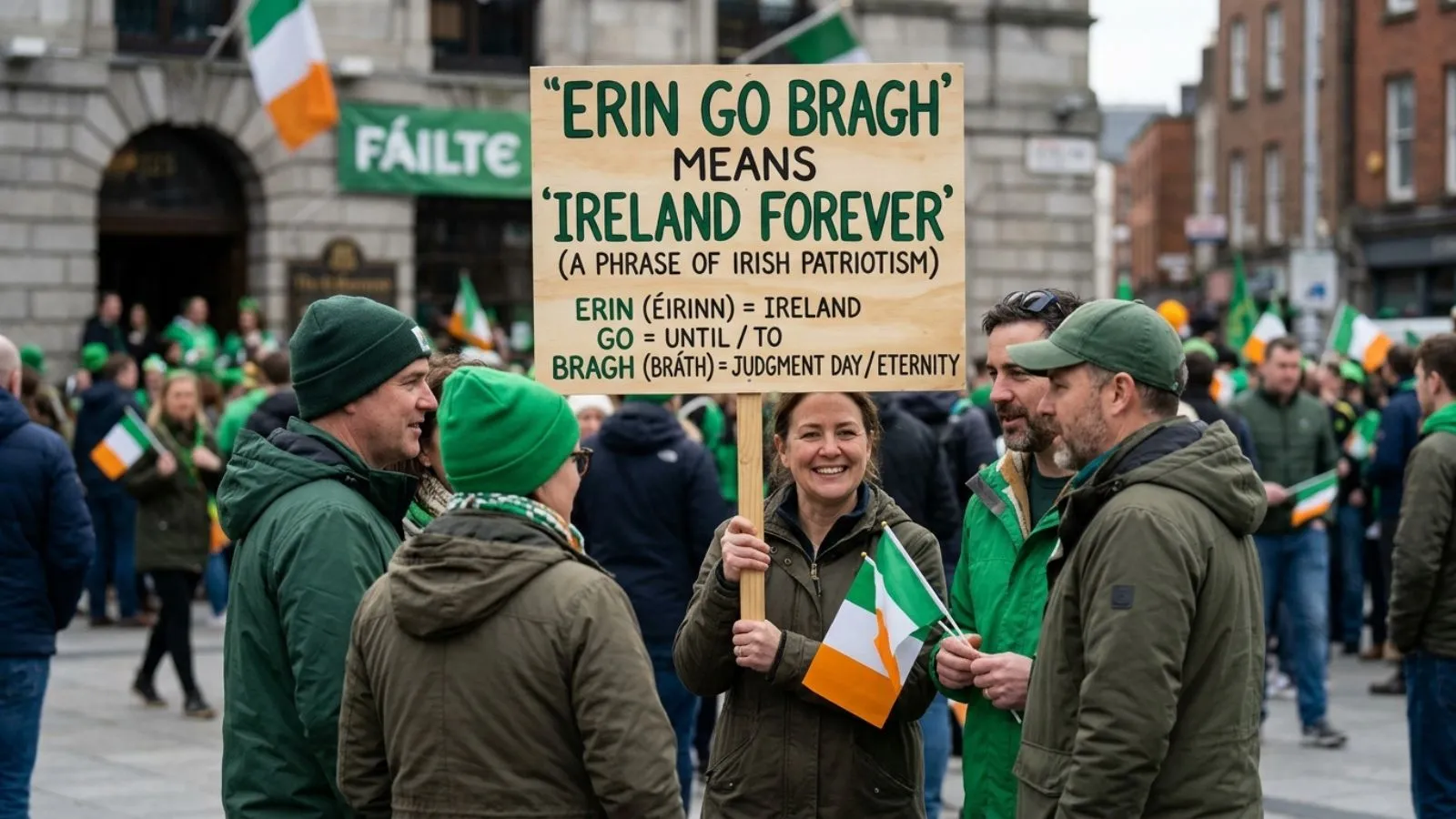
Have you ever heard the phrase “Erin Go Bragh” during St. Patrick’s Day celebrations, Irish events, or even on flags and wondered what it actually means? This powerful Irish expression carries deep historical and cultural significance that goes far beyond its simple sound.
In this article, we will explore the true Erin Go Bragh meaning, its origins, and why it continues to represent Irish pride across the world.
At its core, “Erin Go Bragh” is a poetic Irish phrase that translates to “Ireland Forever.” It has been used for centuries as a symbol of unity, nationalism, and love for Ireland. From historical movements to modern celebrations, this phrase has remained a strong emotional statement for the Irish people and their global diaspora.
In the sections ahead, you’ll discover its linguistic roots, historical background, and how it is still used today in culture, sports, and everyday expressions.
What Does Erin Go Bragh Mean? (Simple Explanation)
The phrase “Erin Go Bragh” is an Irish expression that is most commonly translated into English as “Ireland Forever.” It is not just a direct literal translation, but also a powerful emotional statement that reflects deep love, loyalty, and pride for Ireland and its heritage. The word “Erin” comes from the Irish name for Ireland, Éirinn, which is often used in poetry and songs to represent the country in a more romantic and symbolic way.
The second part of the phrase, “Go Bragh,” is derived from the Irish Gaelic expression meaning “forever” or “until the end of time.” When combined, the full phrase becomes a strong declaration of everlasting support for Ireland and its identity.
Unlike ordinary phrases used in daily conversation, Erin Go Bragh is more symbolic and expressive. It is often used in cultural, historical, and patriotic contexts rather than casual speech. You might see it on banners, flags, or heard during Irish celebrations, especially when people want to show national pride or honor Irish history.
Understanding the Erin Go Bragh meaning helps you see why it has remained so important for centuries. It represents unity, identity, and emotional connection among Irish people and their descendants around the world. Even today, it continues to be a proud slogan that connects modern Ireland with its rich historical past.
Language Origin of Erin Go Bragh
The phrase Erin Go Bragh has its roots in the Irish Gaelic language, also known as Gaeilge, which is one of the oldest living languages in Europe. Like many traditional Irish expressions, it reflects both linguistic history and cultural identity that has been preserved for centuries despite political and social changes in Ireland.
The word “Erin” comes from Éirinn, which is the dative form of Éire, the Irish word for Ireland. Over time, English speakers adopted “Erin” as a poetic and symbolic name for Ireland, especially in literature and songs. This version of the name became popular because it carried a softer, more lyrical tone that suited patriotic and emotional expressions.
The phrase “Go Bragh” is derived from the Irish Gaelic expression go brách, which means “forever,” “eternity,” or “until the end of time.” In older Irish spelling, variations existed due to regional dialects and the lack of standardized writing systems in earlier centuries. When the phrase was anglicized, it became “Go Bragh,” which is still widely recognized today.
Together, the phrase evolved into “Erin Go Bragh,” blending Irish Gaelic structure with English interpretation. This mix reflects Ireland’s complex linguistic history, where English and Irish languages influenced each other over time.
Understanding the language origin of the Erin Go Bragh meaning helps highlight how deeply language is tied to cultural identity. It is not just a phrase—it is a linguistic bridge connecting modern readers to Ireland’s ancient heritage and traditions.
Historical Background of Erin Go Bragh
The phrase Erin Go Bragh became widely recognized during periods of Irish political struggle and national awakening, especially in the 18th and 19th centuries. At a time when Ireland was under British rule, many Irish people began using cultural symbols, language, and slogans to express their desire for independence and national identity. “Erin Go Bragh” emerged as one of the most powerful and emotional expressions of Irish patriotism.
During this era, the phrase was often seen on banners, flags, and revolutionary materials used by Irish nationalist groups. It was not just a decorative slogan—it carried a strong political message that symbolized unity and resistance. Irish soldiers, rebels, and supporters used it to express loyalty to their homeland and hope for a free Ireland.
The phrase also gained importance among Irish emigrants who left Ireland due to famine, poverty, and political unrest. For them, Erin Go Bragh meaning represented a deep emotional connection to their homeland, even while living abroad. It became a way to preserve identity and culture in foreign countries such as the United States, Canada, Australia, and the United Kingdom.
One of the most famous historical uses of the phrase was on the “Erin Go Bragh” flag, which featured symbols of Irish heritage and was used during nationalist movements. Over time, it became a lasting emblem of Irish pride and resistance.
Today, the historical significance of Erin Go Bragh reminds us how a simple phrase can carry centuries of struggle, identity, and cultural pride.
Cultural Significance of Erin Go Bragh
The phrase Erin Go Bragh holds deep cultural significance for Irish people and their descendants around the world. Beyond its literal translation of “Ireland Forever,” it represents a shared sense of identity, pride, and belonging that has been passed down through generations. It is not just a phrase from the past—it continues to live as a cultural symbol in modern Irish life.
In Irish culture, expressions like Erin Go Bragh are often used to celebrate heritage during festivals, especially St. Patrick’s Day, where Irish flags, music, and traditions are proudly displayed. The phrase is commonly seen on banners, clothing, and decorations, symbolizing unity among Irish communities worldwide.
For the Irish diaspora, the Erin Go Bragh meaning carries even deeper emotional weight. Many Irish families who emigrated to countries like the United States, Canada, and Australia used this phrase to maintain a connection with their homeland. It became a reminder of where they came from and a way to keep their cultural identity alive in new environments.
The phrase is also frequently associated with Irish sports, particularly rugby and football, where fans use it to show support for national teams. In this context, it represents teamwork, pride, and passion for the country.
Overall, Erin Go Bragh is more than just a translation of “Ireland Forever.” It is a cultural expression that reflects history, emotion, and unity. Its continued use today shows how strongly Irish identity is tied to language and tradition, making it a timeless symbol of national pride.
Erin Go Bragh in Irish Nationalism
The phrase Erin Go Bragh played a significant role in Irish nationalism, especially during the long struggle for independence from British rule. In political and revolutionary contexts, it became more than just a cultural expression—it turned into a powerful slogan representing freedom, resistance, and national unity.
During the 18th and 19th centuries, Irish nationalist movements used symbols like flags, songs, and phrases to strengthen their cause. Erin Go Bragh meaning, “Ireland Forever,” captured the emotional desire of the Irish people to preserve their identity and gain independence. It was often displayed on banners carried by rebels, political groups, and supporters of Irish self-rule.
The phrase became especially popular among organizations such as the United Irishmen and later independence movements. It was used to inspire courage and solidarity among people who were fighting for political and social change. In this sense, Erin Go Bragh was not just decorative language—it was a declaration of loyalty to Ireland itself.
One of the most well-known historical symbols linked to this phrase is the Erin Go Bragh flag, which featured Irish cultural imagery and was used during nationalist demonstrations and uprisings. This flag helped spread the message of Irish unity both within Ireland and abroad.
For Irish emigrants, the phrase also represented hope and emotional connection to their homeland during times of exile. It reminded them that even far from Ireland, their identity remained strong.
Today, Erin Go Bragh still reflects the spirit of Irish nationalism, reminding people of the country’s long journey toward independence and the enduring pride of its people.
Erin Go Bragh Flag and Symbols
One of the most recognizable cultural representations of the phrase Erin Go Bragh is the historic Erin Go Bragh flag, which has been associated with Irish pride, nationalism, and identity for many years. This flag is not just a decorative item—it is a symbolic banner that reflects the meaning of “Ireland Forever” in a visual form.
The traditional Erin Go Bragh flag often includes iconic Irish symbols such as the harp, which is one of Ireland’s oldest national emblems. The harp represents Irish heritage, music, and cultural tradition. In some versions of the flag, green is the dominant color, symbolizing Ireland’s landscape and its national identity as the “Emerald Isle.” These visual elements together strengthen the emotional message behind the Erin Go Bragh meaning.
Historically, this flag was used during Irish nationalist movements and rebellions as a sign of unity and resistance. It was carried by groups who wanted to express their desire for independence and pride in Irish culture. Over time, it became a powerful symbol not only in Ireland but also among Irish communities abroad.
Today, the Erin Go Bragh flag is often seen during cultural celebrations, especially St. Patrick’s Day parades, sporting events, and Irish heritage festivals. It is also displayed in homes, pubs, and public spaces as a sign of cultural pride.
Beyond the flag, the phrase is also found on souvenirs, clothing, tattoos, and artwork, showing how deeply it has become embedded in modern Irish identity. Together, the flag and phrase continue to represent a timeless message of unity, heritage, and national pride.
How Erin Go Bragh Is Used Today
In modern times, the phrase Erin Go Bragh is still widely used as a symbol of Irish pride and cultural identity, even though it originated centuries ago. While its roots are deeply historical and political, today it is more commonly seen in cultural, social, and celebratory contexts rather than nationalist movements.
One of the most popular occasions where the phrase appears is St. Patrick’s Day. During this global celebration of Irish culture, you can find “Erin Go Bragh” printed on banners, clothing, hats, and decorations. It is often used as a cheerful expression of pride in Irish heritage, especially among people of Irish descent living outside Ireland.
The phrase is also frequently used in sports culture, particularly in rugby, football, and other international competitions where Irish teams compete. Fans use it in chants, slogans, and social media posts to show strong support and unity with their national teams.
In addition, the Erin Go Bragh meaning continues to appear in modern lifestyle elements such as tattoos, jewelry, and fashion designs. Many people choose it as a permanent symbol of their connection to Irish roots, identity, or admiration for Irish culture.
On social media, the phrase is often used in captions, quotes, and hashtags to express pride or celebrate Irish-related events. It has also become a part of tourism branding in Ireland, helping promote cultural heritage to visitors from around the world.
Overall, Erin Go Bragh has successfully transitioned from a historical slogan into a modern cultural expression that continues to unite people through shared heritage, pride, and celebration.
Pronunciation Guide for Erin Go Bragh
One of the most common challenges people face when encountering the phrase Erin Go Bragh is figuring out how to pronounce it correctly. Because it comes from Irish Gaelic origins but is written in an anglicized form, the pronunciation is not immediately obvious from the spelling.
The most widely accepted pronunciation of Erin Go Bragh is: “Air-in go BRAW.” Here’s a simple breakdown to make it easier:
- Erin → sounds like “Air-in”
- Go → pronounced like the English word “go”
- Bragh → pronounced like “braw” (rhymes with “saw” or “raw”)
When spoken smoothly, it becomes: Air-in go braw
This pronunciation reflects how the phrase evolved when Irish Gaelic words were adapted into English usage over time. Since Irish spelling rules differ greatly from English, many traditional phrases like this one can be confusing at first glance.
Understanding the correct pronunciation helps you use the phrase more confidently, especially in cultural or celebratory settings such as St. Patrick’s Day events, Irish festivals, or historical discussions. Mispronunciations are very common, so even learning the basic sound is enough for most casual uses.
The Erin Go Bragh meaning becomes even more meaningful when spoken correctly, as it connects the phrase back to its Irish roots and cultural heritage. Whether you are saying it in a speech, using it in a caption, or simply appreciating its history, pronouncing it properly shows respect for its origin.
Common Misunderstandings About Erin Go Bragh
Although Erin Go Bragh is a well-known Irish phrase, it is often misunderstood, especially by people who are encountering it for the first time. One of the most common misconceptions is that it is a casual greeting or everyday saying in Ireland. In reality, it is not used in regular conversation but instead appears in cultural, historical, or symbolic contexts.
Another misunderstanding is that the phrase has a direct, literal English equivalent in modern speech. While the Erin Go Bragh meaning is commonly translated as “Ireland Forever,” the phrase carries a deeper emotional and cultural significance that goes beyond a simple word-for-word translation. It represents pride, identity, and historical struggle rather than just a statement.
Some people also confuse the spelling and pronunciation. Because it comes from Irish Gaelic, the spelling “Erin Go Bragh” is an anglicized version, and many assume it should be pronounced exactly as it looks. However, the correct pronunciation is closer to “Air-in go braw,” which surprises many learners.
There is also confusion about whether it is a political slogan today. While it did have strong ties to Irish nationalism in the past, in modern times it is mostly used in cultural and celebratory contexts rather than political movements.
Lastly, some people assume it is outdated or no longer relevant. In fact, the phrase is still widely used in festivals, sports events, tattoos, and Irish heritage celebrations around the world.
Understanding these misconceptions helps clarify the true Erin Go Bragh meaning, showing that it is a timeless cultural expression rather than just a simple phrase or slogan.
Erin Go Bragh vs “Ireland Forever”
At first glance, “Erin Go Bragh” and the English phrase “Ireland Forever” may seem like exact translations of each other. While they share the same general idea, there are important differences in tone, cultural depth, and historical context that make them unique in their own ways.
The phrase “Ireland Forever” is a straightforward English expression. It clearly communicates a message of long-lasting support or pride for Ireland. It is easy to understand and is often used in modern, informal contexts where simplicity and clarity are preferred.
On the other hand, Erin Go Bragh meaning goes beyond a literal translation. It carries emotional, poetic, and historical weight rooted in Irish Gaelic tradition. “Erin” itself is a poetic name for Ireland, and “Go Bragh” expresses eternity or forever. When combined, the phrase feels more traditional and culturally rich than its English counterpart.
Another key difference is usage. “Ireland Forever” is typically used as a direct statement, while Erin Go Bragh is often used in cultural, historical, or symbolic settings such as flags, celebrations, sports chants, and heritage events. It feels more connected to Irish identity and heritage rather than just a modern expression.
The emotional impact is also different. Erin Go Bragh often evokes a sense of pride, history, and resistance, especially due to its association with Irish nationalism and diaspora communities. Meanwhile, “Ireland Forever” is more neutral and descriptive.
In summary, while both phrases share a similar meaning, Erin Go Bragh is richer in cultural significance, making it a more powerful expression of Irish identity and tradition.
Erin Go Bragh in Pop Culture
The phrase Erin Go Bragh has found a lasting place in pop culture, extending far beyond its historical and political origins. Today, it appears in music, literature, films, fashion, and even everyday media, helping keep Irish heritage visible in modern global culture.
In music, especially traditional Irish folk songs and Celtic-inspired tracks, the phrase is often used to express pride, nostalgia, and emotional connection to Ireland. Many Irish-American artists and folk bands include references to “Erin Go Bragh” to highlight cultural roots and identity. It is also occasionally featured in modern songs that celebrate Irish heritage or St. Patrick’s Day themes.
In literature and poetry, the phrase has long been used as a symbol of national pride and emotional depth. Writers use it to represent Ireland as a land of history, struggle, beauty, and resilience. This connection helps preserve the Erin Go Bragh meaning as more than just a translation—it becomes a storytelling device.
In films and television, the phrase sometimes appears in dialogue, background details, or set designs that reference Irish culture. It is commonly seen on flags, pub signs, or costumes used to establish Irish identity in a scene.
Fashion and merchandise have also embraced the phrase. T-shirts, hoodies, hats, and accessories often feature “Erin Go Bragh,” especially around St. Patrick’s Day celebrations. This has made it a popular design element for expressing cultural pride.
Irish Diaspora and Global Spread of Erin Go Bragh
The global popularity of Erin Go Bragh is closely tied to the history of the Irish diaspora. Over the centuries, millions of Irish people left their homeland due to famine, poverty, and political unrest, particularly during the 19th century. As they settled in countries like the United States, Canada, Australia, and the United Kingdom, they carried their language, traditions, and cultural expressions with them—including this powerful phrase.
For Irish emigrants, the Erin Go Bragh meaning became a deeply emotional reminder of home. It was more than just a slogan; it represented identity, belonging, and hope for a better future while still staying connected to Ireland. In many immigrant communities, the phrase was used in gatherings, cultural events, and religious celebrations to preserve a sense of unity.
In places like the United States, Irish-Americans embraced Erin Go Bragh as part of their cultural heritage. It appeared on banners, community halls, newspapers, and even political movements that supported Irish independence. Over time, it became a recognizable symbol of Irish identity abroad, not just within Ireland itself.
The phrase also helped strengthen cultural pride among second and third-generation Irish descendants. Even if they no longer spoke Gaelic, expressions like Erin Go Bragh allowed them to maintain a connection to their ancestral roots.
Today, the global spread of the phrase can be seen in St. Patrick’s Day parades around the world, Irish pubs, cultural festivals, and online communities. The Erin Go Bragh meaning continues to unite Irish people and their descendants, no matter where they live, keeping Irish heritage alive across generations and continents.
Modern Symbolism and Identity of Erin Go Bragh
In today’s world, Erin Go Bragh continues to function as a powerful symbol of Irish identity, even though its origins are rooted in history and nationalism. Its meaning has evolved over time, but the emotional core remains the same: pride in Ireland and a strong connection to its heritage.
Modern Irish identity is often expressed through cultural symbols, and Erin Go Bragh stands out because it blends language, history, and emotion in a single phrase. The Erin Go Bragh meaning, “Ireland Forever,” is frequently used to represent unity among Irish people both within Ireland and across the global diaspora.
In contemporary society, the phrase is not limited to political or historical contexts. Instead, it is widely used in everyday cultural expression. You can find it in art, design, music, and social media, where people use it to show pride in Irish roots or simply celebrate Irish culture. This shift shows how traditional expressions can remain relevant even in a modern, digital world.
For many people, Erin Go Bragh is also a personal identity marker. It is used in tattoos, jewelry, and clothing as a permanent reminder of heritage and belonging. In this way, the phrase becomes more than words—it becomes part of personal storytelling.
It also plays a role in global cultural events, especially during St. Patrick’s Day celebrations, where it helps connect millions of people to Irish traditions.
FAQs About Erin Go Bragh Meaning
1. What does Erin Go Bragh mean in English?
The phrase Erin Go Bragh meaning in English is most commonly translated as “Ireland Forever.” It expresses strong pride, loyalty, and love for Ireland and its cultural identity.
2. What language is Erin Go Bragh from?
Erin Go Bragh comes from the Irish Gaelic (Gaeilge) language. It is an anglicized version of the original Irish expression “Éirinn go brách.”
3. How do you pronounce Erin Go Bragh?
It is usually pronounced as “Air-in go braw.” The spelling can be misleading, so the pronunciation is closer to its Gaelic sound rather than English reading.
4. Is Erin Go Bragh still used today?
Yes, it is still widely used today in cultural celebrations, especially St. Patrick’s Day, sports events, Irish festivals, and social media posts related to Irish heritage.
5. Is Erin Go Bragh a political phrase?
Historically, it was strongly connected to Irish nationalism and independence movements. Today, however, it is mostly used as a cultural and celebratory expression rather than a political slogan.
6. What is Erin Go Bragh used for?
It is used on flags, banners, clothing, tattoos, and decorations to show Irish pride and cultural identity.
7. What is the origin of Erin Go Bragh?
It originated from Irish Gaelic language traditions and became popular during Ireland’s historical struggle for independence and among Irish emigrant communities.
Conclusion
In conclusion, the phrase Erin Go Bragh is far more than just a simple translation of “Ireland Forever.” It is a powerful cultural expression that reflects Ireland’s rich history, language, identity, and global influence.
From its roots in the Irish Gaelic language to its strong presence in nationalist movements, the phrase has carried deep emotional and symbolic meaning for centuries.
Understanding the Erin Go Bragh meaning helps us appreciate how language can preserve heritage and connect people across generations. Whether it is used on flags, during St. Patrick’s Day celebrations, in sports chants, or in modern fashion and tattoos, the phrase continues to represent pride, unity, and a lasting bond with Irish culture.
Even today, Erin Go Bragh remains relevant as a timeless reminder of identity and belonging. It connects people not only to Ireland’s past but also to its living cultural presence around the world.

Chris Pickard is a passionate writer who loves to inspire people through meaningful words. As an author at DreamQuotez.com, he focuses on creating uplifting, motivational, and heart-touching quotes that connect deeply with readers.
His work is dedicated to helping people find hope, strength, happiness, and positivity in everyday life.