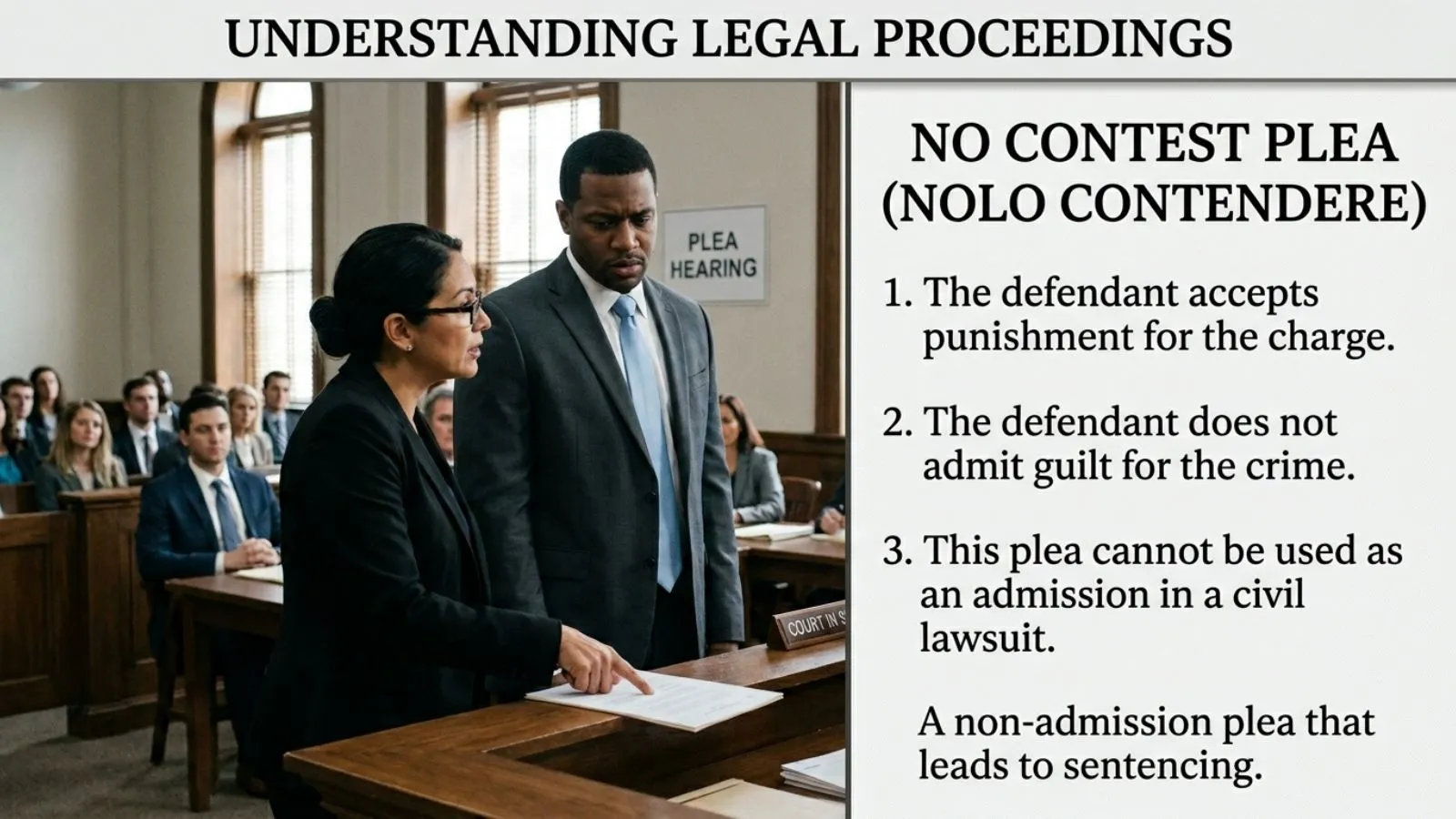
The term “no contest” is often heard in courtroom dramas, news reports, or legal discussions, but many people are unsure about what it actually means.
At first glance, it may sound like someone is simply refusing to participate in a case, but in legal terms, it has a much more specific definition. In court, a “no contest” plea is when a defendant does not admit guilt but also does not dispute the charges brought against them.
This legal option can seem confusing because it sits between “guilty” and “not guilty,” and it carries important consequences depending on the case.
Understanding the no contest meaning is important for anyone trying to make sense of criminal law or legal news. In this article, we will break down what “no contest” really means, how it differs from other pleas, and why someone might choose it in a legal situation.
What Does “No Contest” Mean in Law?
In legal terms, “no contest” comes from the Latin phrase nolo contendere, which means “I do not wish to contend.” When a defendant pleads no contest, they are not admitting guilt, but they are also not challenging the charges brought against them in court. In simple words, they are accepting the court’s punishment without formally saying, “I am guilty.”
It is important to understand that a no contest plea is treated almost the same as a guilty plea in criminal court when it comes to sentencing. The judge can still impose fines, probation, or even jail time depending on the severity of the case. However, the key difference is that the defendant is not directly admitting guilt, which can matter in other legal situations.
One major reason this distinction is important is because of civil liability cases. If someone pleads guilty, that admission can be used against them in a related civil lawsuit. But with a no contest plea, in many cases, it cannot be used as a direct admission of guilt in civil court.
For example, if a person is charged with causing an accident, a guilty plea could make it easier for the other party to sue them for damages. A no contest plea, however, may help limit that risk.
No Contest vs Guilty vs Not Guilty (Complete Comparison)
Understanding the difference between no contest, guilty, and not guilty is key to fully grasping the no contest meaning in court. Although these three pleas may seem similar at first, they lead to very different legal processes and outcomes.
A guilty plea means the defendant fully admits to committing the crime. This is a direct acceptance of responsibility, and the court immediately proceeds to sentencing. In most cases, a guilty plea can also be used as evidence in related civil lawsuits because it is a clear admission of wrongdoing.
A not guilty plea is the opposite. The defendant denies the charges and forces the case to go to trial. During the trial, the prosecution must prove guilt beyond a reasonable doubt. If the defendant is found not guilty, they are legally cleared of the charges.
A no contest plea, however, sits between these two. The defendant does not admit guilt but also does not dispute the charges. The court treats it similarly to a guilty plea for sentencing purposes, meaning penalties can still apply. However, it may not always be used as an admission of guilt in civil court cases, which is one of its main advantages.
Quick Comparison Summary:
- Guilty: Admits crime + full legal responsibility
- Not Guilty: Denies crime + case goes to trial
- No Contest: No admission + accepts punishment
This comparison shows why no contest is often chosen as a strategic legal option, especially when civil consequences are a concern.
Why Do People Plead “No Contest”?
People choose a no contest plea for several strategic legal reasons, even though it still leads to punishment in criminal court. One of the main reasons is to avoid admitting guilt officially. While the court may still treat the outcome like a guilty plea for sentencing, the defendant does not verbally or legally accept responsibility for the crime.
Another important reason is protection against civil lawsuits. In many cases, a guilty plea can be used as strong evidence in a separate civil case, such as personal injury or property damage claims. A no contest plea may help reduce this risk because it is not a direct admission of wrongdoing in some jurisdictions.
Lawyers also sometimes recommend a no contest plea as part of a plea bargain deal. This allows the defendant to resolve the case faster, avoid a lengthy trial, and potentially receive a lighter sentence. It is often seen as a practical solution when the evidence is strong, but the defendant wants to limit long-term legal consequences.
In some situations, defendants may also choose no contest to avoid public statements of guilt, especially in cases involving reputation, employment, or business concerns. Even though the legal outcome may still be damaging, the wording of the plea can matter in future legal or personal matters.
Legal Consequences of a No Contest Plea
Although a no contest plea does not involve admitting guilt, it still carries serious legal consequences in criminal court. In most cases, the judge will treat it almost the same as a guilty plea when deciding punishment. This means the defendant can still face fines, probation, community service, or even jail time depending on the severity of the offense.
One important point is that a no contest plea will usually still result in a criminal record. Even though the defendant does not say “I am guilty,” the court’s judgment remains the same in terms of sentencing and official documentation. This can affect future job opportunities, background checks, and other legal matters.
In addition, a no contest plea may also have indirect effects in civil cases. While it is not always treated as an admission of guilt in civil court, it does not completely protect a person from being sued. In some situations, the facts of the case can still be used against the defendant in a separate lawsuit.
Another consequence is that once a no contest plea is accepted by the court, it is generally difficult to withdraw or appeal, except under specific legal conditions. This makes it a serious decision that should be made carefully, usually with legal advice.
When Is “No Contest” Commonly Used?
A no contest plea is not used in every legal case, but it is fairly common in certain situations where defendants and lawyers want to manage risk or avoid complications. One of the most frequent uses is in traffic violations or minor offenses, where the goal is to resolve the matter quickly without going through a full trial.
It is also commonly used in plea bargain agreements, especially when the evidence against the defendant is strong. Instead of fighting a case that is likely to result in a guilty verdict, the defendant may agree to a no contest plea to close the case efficiently and sometimes receive a reduced sentence or penalty.
Another situation where no contest is often used is in cases that could lead to civil lawsuits, such as car accidents, property damage, or personal injury incidents. In these situations, the defendant may choose no contest to avoid making an official admission of guilt that could be used against them in a separate civil case.
In some corporate or financial cases, companies may also use no contest pleas as part of legal settlements to resolve regulatory issues while limiting reputational damage.
Courts may also accept no contest pleas when it serves the interest of saving time and resources, especially if both sides agree and the facts of the case are not heavily disputed.
Is “No Contest” an Admission of Guilt?
One of the most confusing parts of the no contest meaning is whether it counts as an admission of guilt. The short answer is no—legally, it is not considered an admission of guilt. When a defendant pleads no contest, they are specifically choosing not to admit wrongdoing while still accepting that the court will impose a judgment.
However, this does not mean the outcome is harmless or equal to innocence. In criminal court, a no contest plea is usually treated the same as a guilty plea for sentencing purposes. The judge can still issue penalties such as fines, probation, or imprisonment based on the charges.
The difference becomes more important in civil court cases. In many legal systems, a guilty plea can be used as direct evidence that someone committed an act. A no contest plea, on the other hand, is often not treated as a direct confession. This means it may offer some protection in related civil lawsuits, although it does not guarantee complete immunity.
It is also important to understand that even without an admission of guilt, the court’s judgment still stands. The defendant is still legally responsible for facing the consequences of the charge.
In simple terms, a no contest plea is a legal compromise. It avoids formally saying “I am guilty,” but it does not avoid punishment or legal responsibility. This is why it is often used strategically, especially in cases where civil liability or public admission could create additional problems for the defendant.
Real-Life Example (Easy Scenario Explanation)
To clearly understand the no contest meaning, it helps to look at a simple real-life scenario. Imagine a situation where a driver is involved in a minor car accident. The other driver claims that they were injured and decides to file a legal complaint. The case goes to court, and the evidence is somewhat unclear, but there is enough proof that the driver may be responsible.
Now the defendant has three options: plead guilty, not guilty, or no contest.
If they plead guilty, they are officially admitting they caused the accident. This could directly affect a separate civil lawsuit, where the injured party may use that admission to claim compensation.
If they plead not guilty, the case goes to trial. This means more time, legal costs, and uncertainty, because the court must decide the outcome after hearing both sides.
Instead, the defendant chooses a no contest plea. In this case, they are not saying they caused the accident, but they also accept the court’s punishment, such as a fine or penalty. The judge issues a ruling just like in a guilty plea, but the defendant avoids making a formal admission of fault.
Later, if a civil case happens, the no contest plea may not be treated as direct proof of guilt in the same way a guilty plea would be.
Advantages and Disadvantages of Pleading No Contest
A no contest plea can be useful in certain legal situations, but it also comes with both benefits and drawbacks. Understanding these helps clarify the full no contest meaning in real court practice.
Advantages of a No Contest Plea
One major advantage is that it allows a defendant to avoid formally admitting guilt. This can be important in cases where reputation, employment, or public perception matters. Even though the court still imposes punishment, the defendant does not explicitly say they committed the offense.
Another advantage is reduced risk in civil cases. In some situations, a no contest plea cannot be used as a direct admission of guilt in a related civil lawsuit. This may help protect the defendant from additional financial liability.
It can also help speed up the legal process. By avoiding a full trial, a no contest plea often leads to a faster resolution through plea bargaining, saving time, stress, and legal costs.
Disadvantages of a No Contest Plea
Despite its benefits, a no contest plea still results in legal punishment, which can include fines, probation, or jail time. It is not a way to escape consequences.
It may also still lead to a criminal record, which can affect future job opportunities and background checks.
In addition, once accepted, it is usually difficult to withdraw or appeal, making it a serious and often final decision.
Myths and Misconceptions About No Contest
There are many misunderstandings about the no contest meaning, and these myths often lead people to think it is more powerful or safer than it actually is. Clearing up these misconceptions is important for a proper legal understanding.
One common myth is that “no contest means you are innocent.” This is incorrect. A no contest plea does not prove innocence; it simply means the defendant is not disputing the charges in court. The court can still issue a conviction and impose penalties.
Another misconception is that no contest removes all legal consequences. In reality, the defendant can still face the same punishment as a guilty plea, including fines, probation, or even jail time. The only difference is the lack of a formal admission of guilt.
Some people also believe that a no contest plea cannot affect your record. This is false. In most cases, it still becomes part of the criminal record and may appear in background checks, which can impact employment or travel opportunities.
A further myth is that no contest cannot be used against you in any other case. While it may not always be treated as a direct admission in civil court, it does not guarantee full protection. In some situations, related evidence can still be used in lawsuits.
Frequently Asked Questions (FAQ)
What is the meaning of no contest in simple words?
A no contest plea means the defendant does not admit guilt but also does not dispute the charges in court. The court treats it similarly to a guilty plea for punishment, but without a formal admission of wrongdoing.
Is no contest better than guilty?
It depends on the situation. A no contest plea may be better in cases where a person wants to avoid officially admitting guilt, especially if there is a risk of a civil lawsuit. However, both pleas usually result in similar criminal penalties.
Does no contest give you a criminal record?
Yes, in most cases a no contest plea still results in a criminal record, just like a guilty plea. It can appear in background checks and may affect future opportunities.
Can you go to jail for no contest?
Yes. A no contest plea can lead to the same punishments as a guilty plea, including fines, probation, or jail time, depending on the severity of the case.
Why would a lawyer recommend no contest?
Lawyers may recommend it as a legal strategy to resolve a case quickly, reduce risk in civil lawsuits, or avoid a formal admission of guilt while still negotiating a plea deal.
Is no contest an admission of guilt?
No. It is not considered an official admission of guilt, but the court still treats the defendant as responsible for sentencing purposes.
Conclusion
Understanding the no contest meaning helps clear up confusion around one of the most misunderstood legal terms in court. A no contest plea sits between “guilty” and “not guilty,” where the defendant does not admit guilt but still accepts the court’s punishment.
While it may sound like a way to avoid responsibility, it still carries real legal consequences, including possible fines, penalties, or even jail time.
The main reason people choose this option is often strategic especially to avoid admitting guilt in situations where civil lawsuits or reputation concerns are involved. However, it is not a way to escape a criminal record or legal outcome.
In the end, a no contest plea is best understood as a legal compromise, not a denial of the case and not an admission either. Knowing how it works can help you better understand legal news, court decisions, and the justice system overall.

Chris Pickard is a digital entrepreneur associated with Pickupsy.com. He specialises in content creation and manages online blogs focused on trending topics, emoji meanings, and viral internet content.